

Engagement has become the default metric for social media performance. It's easy to measure, easy to show in a dashboard, and it feels concrete. But for growing businesses, optimising for engagement alone is eventually optimising for the wrong people. Engagement is also easy to artificially increase, through your own comments to posts.
The problem with engagement as your north star
People who already follow you and know you engage more easily. They know your voice. They're primed to react. So when the social team's KPI is engagement (or worse, direct sales, which on LinkedIn are residual compared to paid media anyway), the incentive is to write for the people already there. In B2B, the team is even incentivised to produce content for its own employees, posting about the Xmas dinner or the internal convention rather than being creative for exposing your brand to new potential clients that do not follow you yet.
Content gets written to play well to your existing bubble. The channel loses what makes it valuable: discovery.
What LinkedIn's in-network vs out-of-network split actually means
In June 2026, LinkedIn started showing creators the split between in-network and out-of-network reach on every post. It's simple data, and sharp signal.
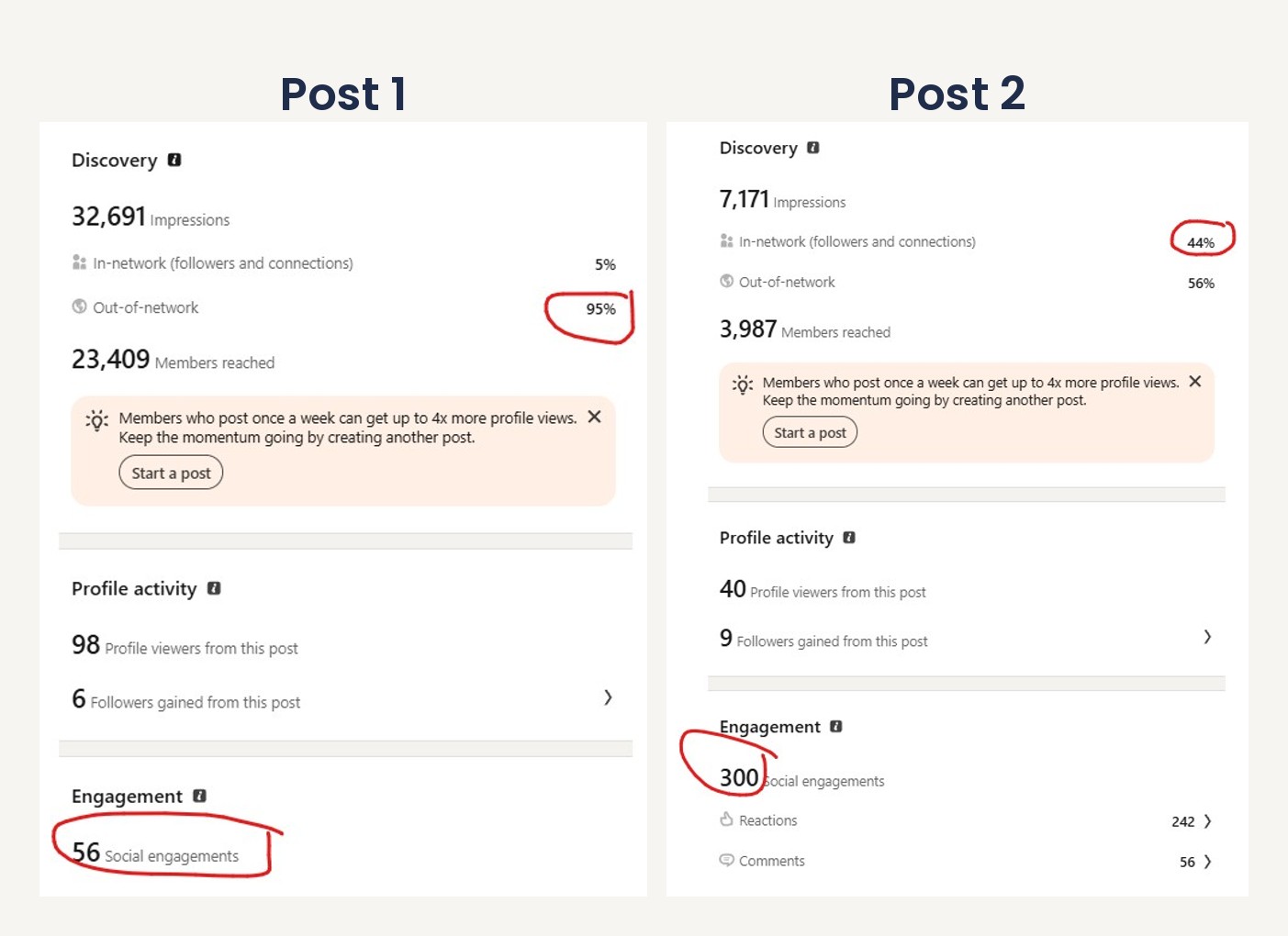
When you look at your post analytics, you'll see something like this:
Post that drove audience growth: 32,691 impressions, 95% out-of-network, 56 engagements
Post that played well to your bubble: 7,171 impressions, 56% out-of-network, 300 engagements
The second post looks like a win: the engagement is higher. But here's the trade: it reached mainly people who were already in your network. This is ok if the objective was to nurture the existing audience, and not good if the objective was to increase brand awareness and find new people.
Why this distinction matters
Your in-network audience is probably getting your message also through email, direct messages, maybe even conversations with your sales team. In this case, LinkedIn is good nurturing and incremental.
But the person who doesn't follow you yet, who finds you through the algorithm because something you wrote mattered to them? That's discovery. That's where LinkedIn's organic real value sits in terms of cost saving compared to paid media reach.
Scaling a business means reaching people who don't know you exist. That doesn't happen through engagement within your own bubble. It happens through out of network reach.
Engagement is still your proof of authority
None of this means engagement doesn't matter. It does. Engagement feeds the algorithm, and it's the social proof that gets you taken seriously, especially by B2B buyers.
When an out-of-network prospect does discover you, they judge your authority by the conversation happening under the post. A high-reach post with an empty comment section signals a lack of industry validation.
So the point is not to drop engagement. Measuring only engagement is what distorts what your team creates.
The incentive problem
When you measure your social team on engagement, you're telling them: write for the people who already follow you, make existing followers happier. That's the game you've set up.
Social teams are not doing something wrong, they're doing what they're measured on. Write something that gets reactions from your followers? That looks like performance. Write something that reaches people who've never heard of you but might become clients later? That has a lower reaction count, likely a lower engagement and it doesn't feel like winning.
However, from an audience growth perspective, the second one is the post that actually matters.
The question
If you had to report one LinkedIn metric to the board, which would it be? Engagement rates from your existing followers, or the number of new people who found you this month organically, saving on paid media cost?
Most social teams are still measured on engagement and therefore focus on nurture. Is this aligned with your LinkedIn strategy?
What to do about it
Start with the why you are posting: do you want to nurture your existing network or to reach new ones or to do both? Then look at your last 20 posts. Which ones drove out-of-network reach? What were they about? What did they do differently?
Then stop measuring your social team on raw engagement alone, especially if your LinkedIn main objective is to scale. Adopt two indicators instead:
- A velocity indicator. Target a % out-of-network split to make sure your message is expanding beyond the people who already know you.
- A validation quality measure. Track meaningful engagement to make sure that reach is actually hitting your Ideal Customer Profile.
Reach gets you on the radar. Engagement keeps you there. Optimise for the sequence, not just one side of the coin.