

When local growth starts to strain the system
Early expansion runs on energy and improvisation. A strong country lead adapts the message, a paid media specialist finds a channel mix that works, and the centre keeps the brand roughly consistent.
It looks like progress. Until the business needs repeatability.
Then the cracks show. Markets use different naming conventions, so nobody can compare performance. Local teams rewrite the positioning because the central version doesn't land. Reporting turns into a debate about definitions instead of a conversation about decisions.
International scale punishes ambiguity. When the strategic centre is unclear, every market fills the gap its own way.
The instinct is to add layers of central control. But centralising every decision slows down the people closest to the buyer. Decentralise everything and you get fragmented execution and data nobody trusts.
Most teams frame this as centralised vs decentralised marketing. At scale the answer is always hybrid. The real work is deciding which calls are global, which are local, and which need both.
From campaign plan to decision architecture
A campaign plan says what launches next month. Decision architecture says who decides the audience, the message, the budget, the channel mix, the measurement model and the point at which you change course.
The copy can change country by country. The evidence has to compare: what worked, for whom, and at what cost. Without that discipline, every market claims success in a language nobody else can translate.
| Area | Owned centrally | Adapted locally | Shared evidence |
|---|---|---|---|
| Positioning | Core category, promise and differentiation | Local proof points and language | Win themes, objections, conversion signals |
| Audience | Priority segments and account criteria | Market maturity and buyer roles | Pipeline quality, sales feedback, intent data |
| Paid media | Investment principles and measurement standards | Channel mix, creative testing, bids | Cost trends, conversion quality, incrementality |
| Operations | Taxonomy, reporting rhythm, governance | Workflow details and market calendar | Decision logs, test results, budget shifts |
Scroll sideways on mobile to see all four columns.
Separate global constants from local variables
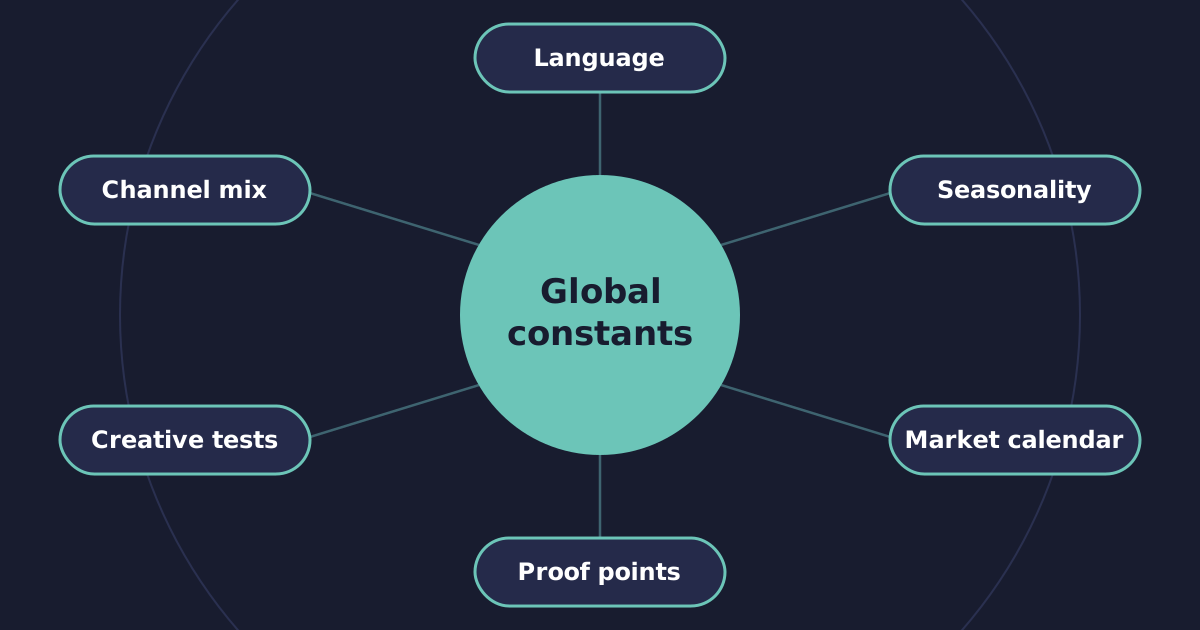
Teams move faster when they know what won't change. Global constants are things like the category narrative, strategic segments, brand guardrails and commercial priorities. They give the business a stable centre.
Local variables are translation choices, media mix, seasonality, buying cycles and more. Treat them as minor execution details and you'll pay for it. Cultural fit decides whether buyers trust you and whether they convert.
A strategy that lasts treats market differences as inputs.
Paid media is the pressure test
Paid media exposes a weak strategy faster than almost any other channel. When the strategy is unclear, paid teams compensate with targeting tweaks, bid changes and short-term tests. None of it fixes the underlying problem.
It's usually a chain of small gaps. Campaigns built on headquarters assumptions. Creative that translates the words but not the intent. Reporting that rewards cheap leads over commercial quality.
So an international paid media audit has to look well past account hygiene. When I run one, I take every division through the same six lenses: the business and its operating model, who does what (org charts, RACI, agencies and contracts), measurement, the marketing mix, innovation maturity, and what to do next.
That's how I approached a global paid media audit for a financial services enterprise: 4 divisions, every region, 25+ stakeholder interviews and one comparable baseline in 12 weeks.
Marketing operations set the rhythm
Shared briefing templates. One campaign taxonomy and naming convention. A common budget review cadence, decision records and clear escalation paths.
That's the plumbing. It tells you whether a learning from France can help Germany, whether a paid social test can inform search messaging, and whether leadership can compare country performance at all.
At scale, a strategy survives when operations make the right behaviour easy. And if leaders want AI-ready marketing on top of messy inputs, inconsistent definitions and undocumented decisions, AI will amplify the disorder. It acts on the structure you give it. The same goes for how AI tools read your brand across markets.
Where to start
Rebuilding for international scale doesn't mean pausing execution for a long theoretical exercise. The best work starts by looking at why the current operating model is breaking.
- Find the decision friction. Where do teams wait too long for approval? Where do local teams quietly ignore central guidance? Where does leadership distrust the numbers? That's where the strategy isn't explicit enough.
- Group markets by maturity rather than geography. Two countries on different continents can share the same growth problem, while neighbours need completely different motions. Maturity groups let teams share playbooks without forcing everyone into one global template.
- Write down the constants and the variables. Global non-negotiables short enough to remember and strong enough to matter. Clear permission for local teams to adapt where they have better evidence.
- Rebuild paid media governance around market maturity and evidence quality.
- Install a learning rhythm. Regular reviews, a shared test library, clean reporting and decision records that explain why budgets moved.
Simple sequence. Not an easy one.
Frequently asked questions
Should international marketing be centralised or decentralised?
Neither in full. Centralise the decisions that need to compare across countries: positioning, priority segments, investment principles, measurement and taxonomy. Decentralise the ones that depend on local evidence: language, proof points, channel mix, seasonality and creative tests. Draw the line decision by decision, and write it down.
How often should international teams review their marketing strategy?
Quarterly for strategic decisions, monthly for budget, channel and campaign adjustments. Fast-moving markets may need more frequent check-ins, but the cadence should never get so heavy that teams spend more time reporting than improving.
Should local markets control their own paid media budgets?
Local teams should influence budget decisions, because they know market conditions, competitor pressure and buyer behaviour. The centre still sets investment principles, measurement standards and governance, so budget decisions stay comparable across countries.
What is the clearest sign that international marketing has stopped scaling?
Growth depends on individual heroics rather than a repeatable system. If every country needs a custom workaround, every report needs manual interpretation and every campaign debate goes back to first principles, the operating model has fallen behind the business.
Can one brand message work across all markets?
The core promise can travel. The proof usually needs to change. Keep the same strategic meaning and let local teams adapt examples, claims, language and objections to the way buyers in that market decide.
From expansion to orchestration
International scale changes the job of marketing leadership. Less time approving every campaign, more time designing the conditions for consistent, intelligent execution across markets.
If your strategy has grown through market-by-market fixes, it probably needs a more deliberate operating model. And if you need someone senior to run it while you hire, that's what fractional leadership is for.
Growth moving faster than your marketing system?
I work with international teams on exactly this: finding where decisions stall, then rebuilding the operating model around it.
Not ready to talk yet? Start self assessing in 5 minutes, for free.